Lighting & heat
How reptile thermostats work
Three control types, one rule: a light-emitting heat source needs a dimming or proportional controller, because an on/off unit will strobe it.
By Brijon M.Last updated
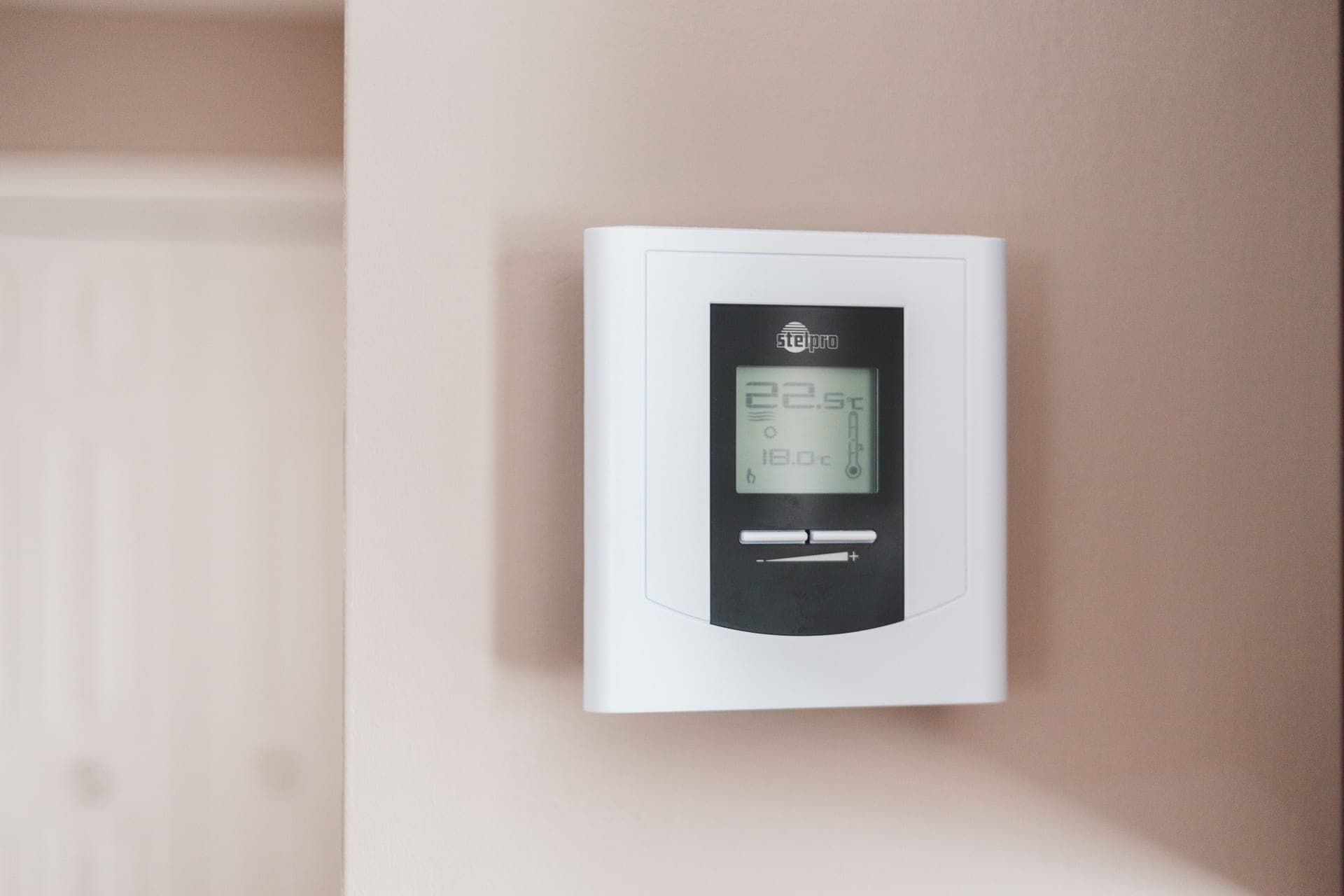
A reptile thermostat reads a probe and modulates power to the heat source to hold a setpoint. On/off switches the circuit fully on and off; pulse proportional sends rapid pulses; dimming varies voltage continuously. Light-emitting bulbs need dimming. Lightless emitters and mats work with any of the three.
Shed & Bask earns a commission from qualifying Amazon purchases made through links on this page. It does not change what we recommend or the order we rank things in. Read the full disclosure.
What all three have in common
Every reptile thermostat does the same job: read the temperature at a probe, compare it to a setpoint, and change the power going to the heat source. The differences are in how the power is changed, and that single difference decides which heat sources a given controller can drive.
On/off (relay)
The simplest design. When the probe reads below setpoint, the relay closes and the heat source runs at full power. When it reads above, the relay opens and the heat source gets nothing. Temperature oscillates in a band around the setpoint, with the width of the band set by the controller's hysteresis.
- Good for: ceramic heat emitters, heat mats, radiant panels - anything lightless with enough thermal mass to smooth the oscillation.
- Wrong for: any bulb that emits visible light. The strobing is visible, unpleasant for the animal, and hard cycling shortens filament life.
Pulse proportional
Instead of switching fully on and off, the controller sends rapid pulses of electricity, with the pulse rate varying by how far the probe is from the setpoint. The result is very stable temperature with minimal fluctuation, and this control type is used more in professional and breeding setups.
- Good for: lightless sources, where stability matters.
- Wrong for: light-emitting bulbs, because the pulsing is still visible.
Dimming proportional
Varies the voltage continuously, the way a household light dimmer does. The bulb settles at whatever brightness holds the setpoint, with no visible flicker. This is the most broadly compatible control type and the only one suitable for a halogen or incandescent basking lamp.
- Good for: everything, including halogen basking lamps.
- Wrong for: nothing, other than being more expensive than you need if your only source is a mat.
| Control type | Power behavior | Suitable heat sources | Temperature stability |
|---|---|---|---|
| On/off | Full on, full off | CHE, heat mat, radiant panel | Oscillates around setpoint |
| Pulse proportional | Rapid pulses, rate varies | CHE, heat mat, radiant panel | Very stable |
| Dimming proportional | Continuous voltage variation | All, including halogen | Very stable |
Probe placement is the other half of the system
A thermostat controls the temperature at its probe and nothing else. Place it where the published figure applies: at the basking surface for a bearded dragon, inside the warm hide for a ball python (the published targets are hide temperatures), between the heat pad and the glass for a hatchling crested gecko on a mat - which is the exact placement the guidance specifies so the gecko is never exposed above 85 F.
What to look for when buying
- Control type that matches your heat source. This is the first filter, not a feature.
- High and low temperature alarms, so a probe failure is announced.
- A published maximum load per channel that covers your source.
- A remote probe long enough to reach where the figure is measured.
- Enough channels for what you actually run. Two singles cost more than one dual and give you two places to check.
Two channels, proportional
Vivarium Electronics VE-300X2 Dual Proportional Thermostat
Two independent true-proportional channels at a stated 600 W each, with high and low alarms.
One channel, dimming
Spyder Robotics Herpstat 1 Proportional Thermostat
Dimming output for a halogen basking lamp, with an alarm. The right single-enclosure answer.
Frequently asked questions
How does a reptile thermostat work?
It reads the temperature at a probe you position in the enclosure, compares it with your setpoint, and changes the power reaching the heat source - by switching it on and off, pulsing it, or dimming it continuously.
Can I use an on/off thermostat with a heat lamp?
Not with a light-emitting lamp. The lamp will visibly flash on and off at every cycle, which is disruptive to the animal and hard on the filament. Use a dimming thermostat for any bulb that produces light.
Where do you put a reptile thermostat probe?
Wherever the published figure is measured. Basking surface for a bearded dragon, inside the warm hide for a ball python, and between the mat and the glass for a hatchling crested gecko on a heat pad.
Sources
- Ball Python Humidity & Temperature Requirements — ReptiFiles
- Crested Gecko Temperatures & Humidity — ReptiFiles
- Bearded Dragon Temperatures & UVB Requirements — ReptiFiles
Read next
Hub
Reptile UVB, heat and thermostats
Wattage and percentage tell you almost nothing on their own. UV index at a stated mount distance is the number that decides whether a lamp is right for your animal.
Lighting & heat
Best reptile thermostats (2026)
Thermostats ranked by control type, stated accuracy, load ceiling and whether they alarm on failure.
Lighting & heat
Can a reptile heat lamp start a fire?
The three ways a reptile heat lamp causes a fire, and the control for each.
Lighting & heat
Best reptile heat lamps and heat sources (2026)
Heat sources ranked by infrared band, thermostat compatibility and the species basking figure they can reach.
Lighting & heat
Best reptile thermometers and humidity gauges (2026)
The two instruments that can actually read the published figures: an infrared gun and a probe combo.