Guides
9 beginner reptile setup mistakes that cost the most
Ordered by what they actually cost you - in replaced equipment first, and in vet bills second.
By Brijon M.Last updated

Shed & Bask earns a commission from qualifying Amazon purchases made through links on this page. It does not change what we recommend or the order we rank things in. Read the full disclosure.
1. Buying the complete starter kit
A kit is assembled to a price, and the price is met by cutting the three most expensive correct things: enclosure size, UVB quality and temperature control. The typical kit contains a tank below the published minimum, a compact coil UVB bulb that cannot hold a Ferguson zone target across a basking zone, and no thermostat whatsoever. You replace all three, and the tank is the one that hurts, because a second enclosure costs the full price of the first.
2. Shopping by gallons instead of floor area
Published minimums are stated in length, width and height for a reason. A leopard gecko needs 36 x 18 x 18 in with at least 4.5 sq ft of floor space - 4.5 sq ft of floor, which is 648 square inches. A 20-gallon long gives about 2.5 sq ft. Both are sold as adult leopard gecko housing. Use the size chart and compare length times width.
3. Running a heat source with no thermostat
This is the one that can injure an animal on day one. An uncontrolled heat source has no upper limit other than the ambient temperature it eventually reaches, and the enclosure it is sitting on is often wooden or plastic. A thermostat is not an accessory; it is the thing that makes the heat source safe. The fire safety guide covers the failure modes.
The minimum viable thermostat
Inkbird ITC-308 Temperature Controller
A dual-relay on/off controller with a stated 58-248 F range and plus or minus 0.5 F accuracy. Fine for a lightless emitter or a mat. Do NOT use it on a halogen basking lamp - on/off switching will strobe it.
4. Trusting a stick-on dial thermometer
The adhesive dial gauges sold at the till are not accurate enough to set an animal's environment by, and the care references say so directly. You need two instruments: a probe thermometer and hygrometer for air in the zone you care about, and an infrared gun for the basking surface, because the published basking figures are surface figures.
For basking surface temperature
Infrared Temperature Gun
The published figures - 108-113 F for a dragon, 94-97 F for a leopard gecko - are surface temperatures. A probe in the air cannot read them.
For the air gradient and humidity
Zoo Med Digital Thermometer and Humidity Gauge
A remote probe you place where the animal actually is, rather than a sensor stuck to the glass.
5. Buying a UVB bulb by wattage
Wattage describes power draw, not ultraviolet output. The number that matters is UV index at the basking surface, and that is a function of the lamp, the fixture reflector, the mount distance and how much your mesh blocks. The distance guide explains how to set it.
6. Using a compact coil UVB bulb
A coil lights a point. A linear T5 HO tube lights a zone, which is what a basking area is. Every published distance figure on this site assumes a linear tube in a reflector fixture - there is no coil equivalent for most of them.
7. Putting glass or plastic between the lamp and the animal
UVB is blocked by glass and plastic. A fixture with a protective shield over the tube renders the lamp useless for its actual purpose, and the keeper has no way of knowing because the visible light still looks fine. A naked UVB bulb is the working one.
8. Never replacing the UVB bulb
UVB output declines long before visible light does. T5 fluorescent tubes are replaced every 12 months regardless of appearance. The replacement guide covers how to track it, and a UV meter turns the calendar into a measurement.
9. Fixing a shedding problem by misting the whole enclosure
For a leopard gecko this is actively harmful: the species wants 30-40% ambient, with a humid hide at 70-80% ambient, and raising whole-enclosure humidity to solve a shed makes the animal ill. The correct fix is a humid hide at 70-80% placed at the middle to cool end. One hide, not a wetter enclosure.
The species starter-kit roundups put this into practice per animal: bearded dragon, leopard gecko, ball python, crested gecko.
Frequently asked questions
What is the biggest mistake new reptile keepers make?
Buying a complete starter kit. It bundles an undersized enclosure, a coil UVB bulb and no thermostat - the three items that get replaced first, and the enclosure is the expensive one to replace.
Do I really need a thermostat for a reptile?
Yes. An uncontrolled heat source has no upper limit, which is both a burn risk to the animal and a fire risk to the enclosure. The control type must match the source: dimming or pulse-proportional for a light-emitting lamp, on/off only for a lightless emitter or mat.
What should I buy first for a reptile setup?
The enclosure at full adult size, then the thermostat, then the heat source, then the measuring tools. Substrate, decor and lighting can follow. A correct thermal gradient cannot wait a week; a nice piece of cork bark can.
Sources
- Bearded Dragon Temperatures & UVB Requirements — ReptiFiles
- Leopard Gecko Temperatures & Humidity — ReptiFiles
- Leopard Gecko Terrarium Size & Lighting Requirements — ReptiFiles
- Heating equipment and home fire safety — National Fire Protection Association
Read next
Hub
Reptile enclosure guides and comparisons
The cross-species decisions: what material to buy, how big it has to be, whether to build it yourself, and which beginner mistakes are expensive.
Guides
Reptile enclosure size chart
Minimum enclosure footprints by species and life stage, in inches, cm and gallons.
Lighting & heat
Can a reptile heat lamp start a fire?
The three ways a reptile heat lamp causes a fire, and the control for each.
Lighting & heat
When to replace a reptile UVB bulb
The 12-month replacement rule, why visible light misleads, and how to track it.
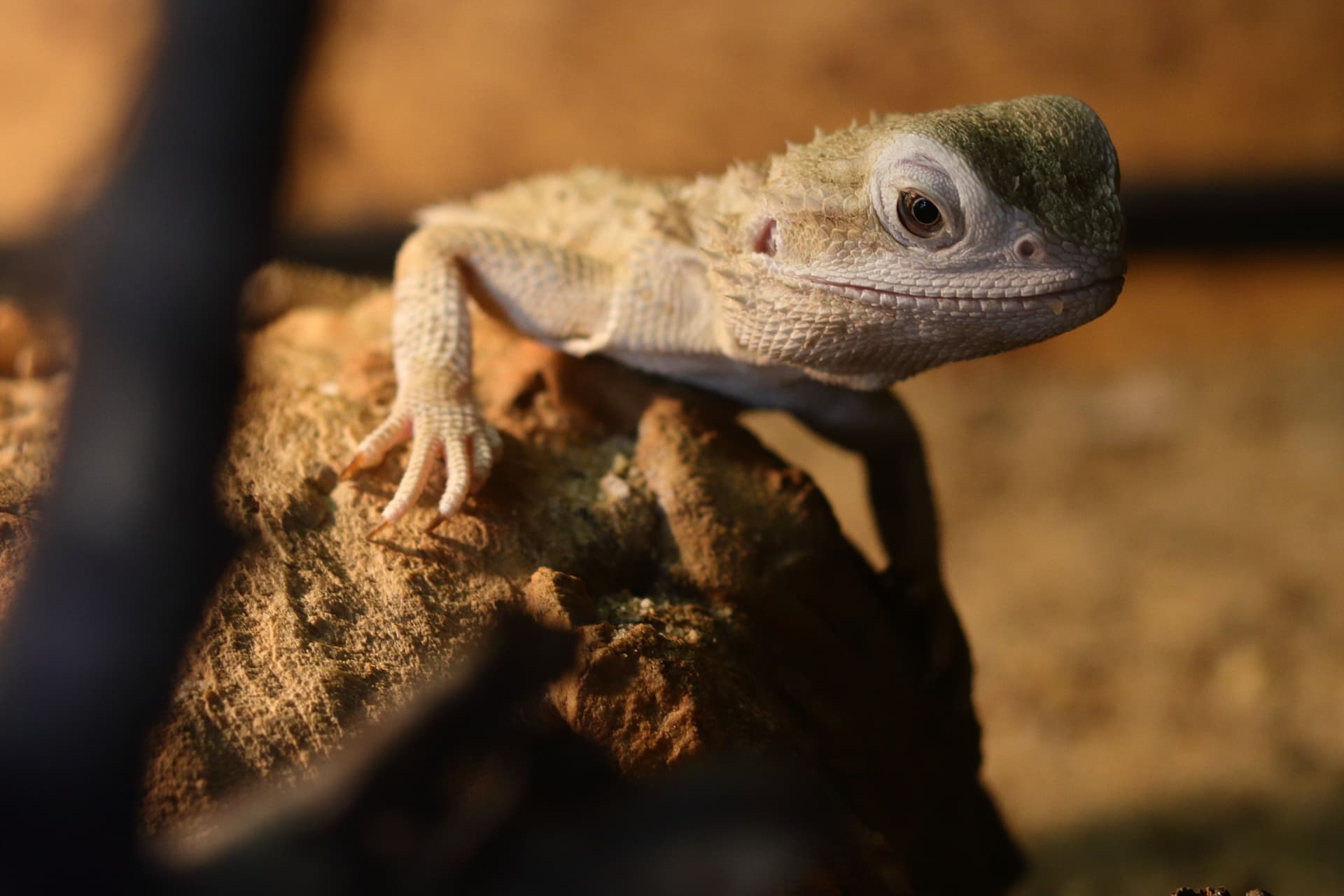
Bearded dragon
Best bearded dragon starter setup (2026)
The component list that replaces a starter kit, in the order to buy it.
Leopard gecko
Best leopard gecko setup for beginners (2026)
The leopard gecko beginner component list in buying order, with the three-hide rule.